
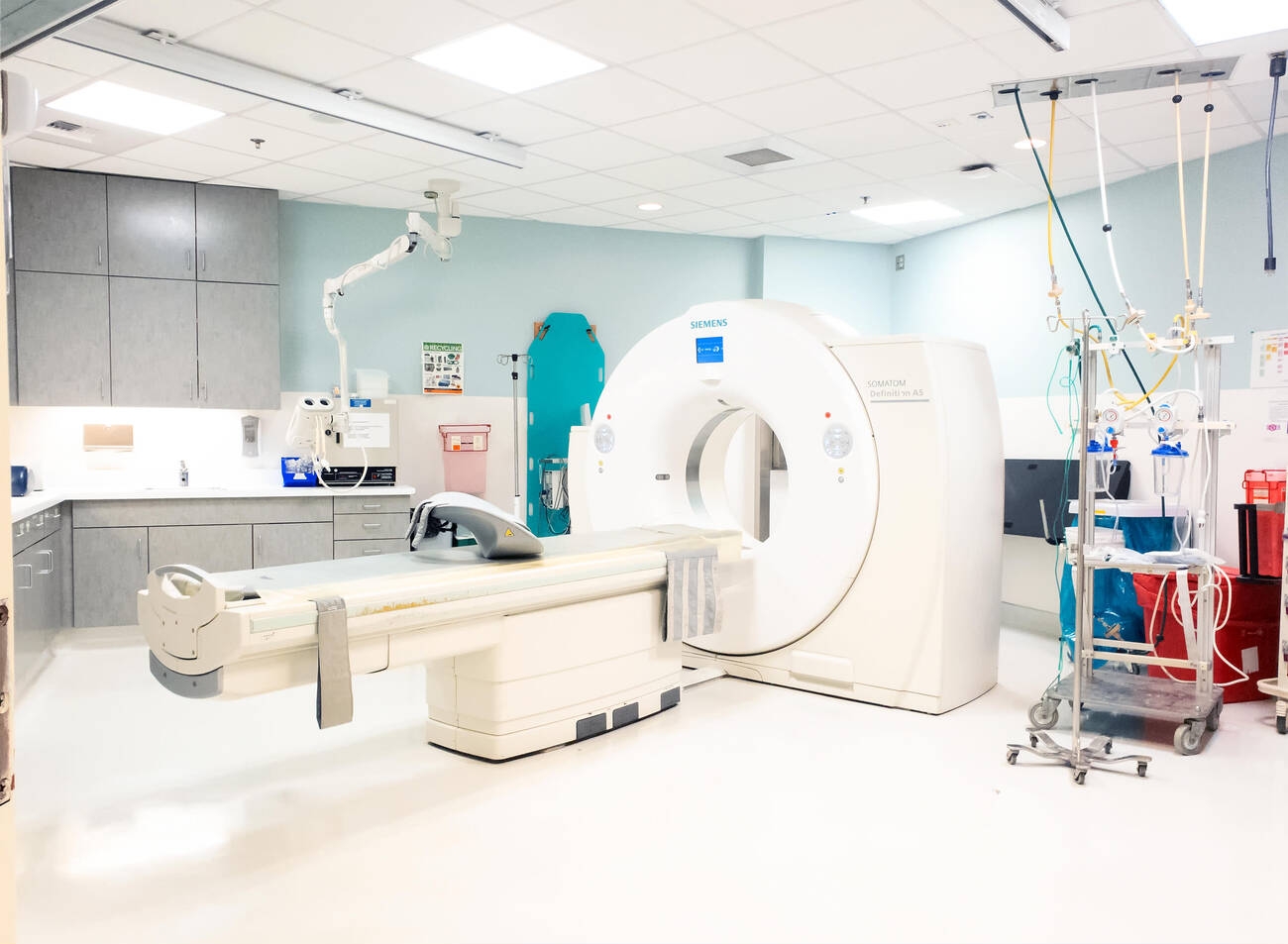
Most people who get a CT scan of their belly are not there to look for stomach cancer. They have a kidney stone, or vague pain, or they are being tracked for something else entirely. The scan is done without contrast dye, the radiologist checks whatever they were asked to check, and the rest of the image quietly goes unread. Buried in that unread space, sometimes, is an early tumor that nobody was looking for.
A team based mostly in Zhejiang, China, working with engineers from Alibaba's DAMO Academy, built a tool to read that overlooked space. They call it GRAPE, for Gastric Cancer Risk Assessment Procedure with Artificial Intelligence. The idea is almost stubbornly practical. Stomach cancer is one of the deadliest cancers worldwide, and it is deadly largely because it is usually found late. The standard screening method, threading an endoscope down the throat, is uncomfortable, needs a specialist, and in most high-risk regions simply cannot be offered to everyone who might benefit. Meanwhile millions of noncontrast CT scans are already being taken every year for other reasons. GRAPE tries to squeeze a cancer screen out of scans that already exist.
Teaching a model to see a hard-to-see cancer
Gastric cancer is genuinely difficult to spot on a plain CT. The stomach wall folds and collapses, the tumor blends into normal tissue, and without contrast the boundaries are faint. The researchers trained their deep-learning model on data from two hospitals, using 3,470 confirmed cancer cases and 3,250 cases without cancer. Then they tested it on scans it had never seen.
The numbers held up in a way that early AI-imaging tools often do not. On an internal test set of 1,298 cases, the model's area under the curve, a standard measure where 1.0 is perfect and 0.5 is a coin flip, was 0.970. On a tougher external set of 18,160 cases drawn from 16 different centers, with all the messy variation that comes from different scanners and different patients, it still reached 0.927. Performance improved as tumors grew larger, which you would expect, but it did not depend on where in the stomach the cancer sat.
The team also put GRAPE head to head with radiologists reading the same scans. The model came out ahead, improving sensitivity by about 22 percentage points and specificity by 14. The gap was widest for early-stage disease, which is exactly the case that matters most and is hardest for a human eye to catch on a noncontrast image.
The part that counts: real hospitals, real scans
Reader studies are one thing. What makes this work stand out is that the team then ran GRAPE across 78,593 consecutive noncontrast CT scans from a cancer center and two regional hospitals, simulating opportunistic screening where the tool simply looks at whatever comes through the door. At the two regional hospitals, among the people it flagged as high risk, gastric cancer was confirmed in 24.5% and 17.7% of cases. Of those detected cancers, roughly a quarter were caught at the T1 or T2 stage, meaning still early and more treatable.
GRAPE also picked up cancers that radiologists had initially missed on the original reports. In some patients, the scan had been done to follow an unrelated condition, and the tumor was found only because the model went back and looked. That is the whole promise of opportunistic screening in one sentence: a cancer caught during a scan taken for something else.
What the study can't say yet
A high detection rate among flagged patients is encouraging, but it is not the same as knowing how many cancers the tool misses across a whole population, or how often it raises a false alarm that sends a healthy person for an unnecessary and invasive endoscopy. Those tradeoffs decide whether a screening tool helps or harms at scale, and this work does not fully settle them.
The data also comes almost entirely from China, where gastric cancer is common and where the model was trained on local populations and scanners. Whether it performs as well in places with different disease rates, different equipment, and different patient bodies is an open question. And the deepest question in all cancer screening remains unanswered here: finding more early tumors is only worthwhile if it actually lets people live longer, and proving that takes years of follow-up, not a snapshot of detection rates. The authors have registered a clinical trial, which is the right next step.
Still, the reframing is worth sitting with. The scans are already being taken. The images already exist. For once, the resource-limited setting where screening is hardest may be the one with the most to gain, because a model that reads scans nobody was going to read again costs almost nothing to run. If the survival benefit follows, that is a cheap way to catch a cancer that usually announces itself too late.
Hu C et al. "AI-based large-scale screening of gastric cancer from noncontrast CT imaging." Nature Medicine, 2025. doi.org/10.1038/s41591-025-03785-6
PubMed PMID: 40555751.
Photograph: Goleisureintl, CC BY 4.0, via Wikimedia Commons.
Comments