
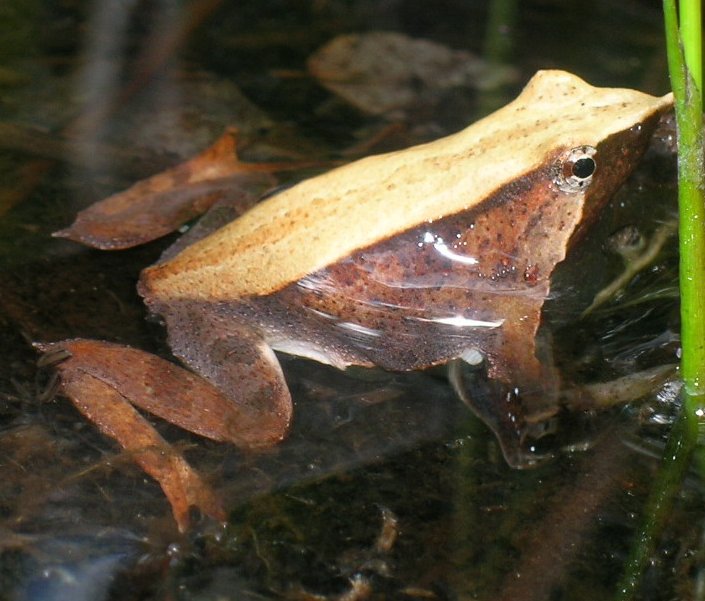
Darwin's frog does something odd for an amphibian. It never really goes back to the water. The males brood their young inside their vocal sacs, and the animals spend their lives in the damp leaf litter of southern Chile's temperate forests. So it is strange that the thing killing them is a fungus that lives in water.
That fungus is Batrachochytrium dendrobatidis, usually shortened to Bd, the chytrid pathogen blamed for amphibian declines on nearly every continent. It infects the skin, wrecks the animal's ability to balance salts and water, and can stop a heart. Most work on Bd has tracked it in ponds and streams, where infected larvae mix and the spores move freely. A fully terrestrial host was supposed to be a harder target. A new paper in Nature Ecology & Evolution shows it is not.
Counting frogs metre by metre
Andres Valenzuela-Sanchez and colleagues followed several populations of Rhinoderma darwinii across southern Chile using high-resolution spatial capture-recapture, where each frog's location is logged precisely enough to map who sits near whom. They paired years of demographic monitoring with an individual-based computer model built from the field numbers, then asked a simple question: where does infection actually happen?
The answer was that it clusters at a startlingly small scale. Infection risk varied over distances of just metres. Frogs living close to an infected neighbor were far more likely to carry Bd themselves, which points to direct, local transmission rather than a pathogen drifting evenly through the forest. In a terrestrial animal with no shared pool of water to seed infection, proximity is the whole story.
That local clustering has teeth. In the affected groups, the model and field data showed subpopulation declines of up to 98 percent within a single year. A cluster of frogs could essentially vanish while the broader population still looked more or less intact.
Why the crash stayed invisible
The most unsettling part of the study is about what we fail to see. Because infection stays penned into small patches, epidemics in one cluster are spatially decoupled from the rest. Zoom out to the level people usually monitor, and the average infection numbers stay muted. The collapse is real, but it is buried in the aggregate.
The authors put it as a general principle: the scale at which you observe a system shapes what you can detect. A survey that samples a whole forest population at coarse resolution can miss violent, localized die-offs entirely. For a threatened species, that blind spot is not academic. It is the difference between catching a crash while intervention is still possible and finding out afterward.
This also reframes what Bd can do. The pathogen has long been associated with catastrophic amphibian losses, but a lot of that reputation comes from aquatic-breeding species. Showing genuine epidemic dynamics and rapid collapse in a fully terrestrial host widens the range of animals that should be considered at risk, and it argues that fine-scale spatial structure deserves more attention in disease ecology generally.
What the study cannot settle
A few things are worth holding in mind. The work centers on one species in one region, so the metre-scale clustering it documents may not generalize cleanly to other terrestrial amphibians or other landscapes. The dramatic 98 percent figure is an upper bound for the hardest-hit subpopulations, not a blanket rate across all the frogs studied. And much of the fine-scale transmission picture rests on a model fitted to the field data; models are only as good as the estimates fed into them, even careful ones like these. What the paper establishes firmly is that hidden, spatially structured epidemics are possible here, and that how we look changes what we find.
For Darwin's frog, already listed as endangered and already squeezed by habitat loss, that is a pointed message about monitoring. Watching the average may be watching the wrong thing. The animals are disappearing in pockets, quietly, a few metres at a time.
Valenzuela-Sanchez, A. et al. "Localized transmission of an aquatic pathogen drives hidden epidemics and population collapse in a terrestrial host." Nature Ecology & Evolution, 2026. doi.org/10.1038/s41559-025-02930-1
PubMed PMID: 41482585.
Photograph: Mono Andes, CC BY-SA 2.0, via Wikimedia Commons.
Comments