


When monkeypox spread across dozens of countries in 2022, the diagnostic bottleneck was not the science. Labs knew how to find the virus. The problem was speed and reach. A patient walks into a clinic, a swab gets shipped to a central lab, and the answer comes back a day or two later. By then the person has gone home, and so has any chance of catching a chain of transmission early.
A team led by Zhen Huang, working across Tulane University and hospitals in China, set out to close that gap. Their tool, described in Nature Communications, is a CRISPR-based test they call TRACE. It runs in a single tube, needs minimal equipment, and returned a monkeypox result in as little as 11 minutes.
Why one-pot CRISPR tests keep tripping over themselves
CRISPR diagnostics work by pairing a guide RNA to a viral sequence. When the target is present, a Cas enzyme wakes up and starts chewing through reporter molecules, releasing a signal you can read. The catch is a tension between two steps. You want to first copy the target DNA to boost sensitivity, then let the CRISPR machinery search for it. Cram both into one tube and they fight each other, which is why many one-pot tests trade away sensitivity for convenience.
TRACE gets around this with temperature. The name stands for thermally regulated asynchronous CRISPR-enhanced assay. By programming when each reaction runs hot or cool, the researchers staggered the amplification and detection steps inside the same tube instead of letting them compete. The payoff was a detection limit of 2.5 copies per test, which the authors report is roughly 40 times lower than a standard one-pot CRISPR approach.
That sensitivity matters because early infections carry very little virus. A test that needs a large viral load to fire will miss exactly the patients you most want to catch.
Matching PCR, but faster and in the clinic
Numbers on purified samples are one thing. Real patient specimens are messy. The team ran TRACE on clinical samples of several types and reported 99.5 percent accuracy. In outpatient settings, the point-of-care version delivered performance comparable to qPCR, the current benchmark, while cutting the time to a result by fivefold.
The authors also note the test meets ASSURED criteria, a World Health Organization checklist for diagnostics meant to work in low-resource settings. The framework asks whether a test is affordable, sensitive, specific, user-friendly, rapid, equipment-free, and deliverable to the people who need it. Meeting it is the difference between a clever lab method and something a nurse can actually use in a crowded clinic.
TRACE adds one more feature that sounds small but is not. It can detect a pathogen gene and a human host gene in the same run. Most one-pot CRISPR tests lack an internal control, so a negative result is ambiguous. Did the sample truly contain no virus, or did the reaction simply fail? Reading a host gene alongside the target gives the test a built-in check that the chemistry worked.
What the study does not settle
This is a proof-of-concept demonstration, not a deployed product. The clinical evaluation covered specific sample types and outpatient settings, and broader validation across more sites, virus variants, and everyday operators is the natural next step. Speed records measured under controlled conditions can slip when a test faces the full variety of real samples and hurried hands. And while the platform was designed to detect multiple DNA targets, most of the marquee results center on monkeypox and a handful of gene targets rather than a sprawling panel.
Still, the direction is clear. The value of a diagnostic is not only how accurate it is but how fast and how close to the patient it can run. During the 2022 outbreak, the tools existed but sat too far from the point of care. A one-pot CRISPR test that reports in minutes, carries its own quality control, and holds up on clinical samples is aimed squarely at that failure. The mpox emergency has cooled, but the same design problem returns with every new outbreak, and this is one attempt to be ready before the next one arrives.
Huang, Z. et al. "Thermally programmed one-pot CRISPR assay for on-site pandemic surveillance." Nature Communications, 2025. doi.org/10.1038/s41467-025-65193-1
PubMed PMID: 41271690.
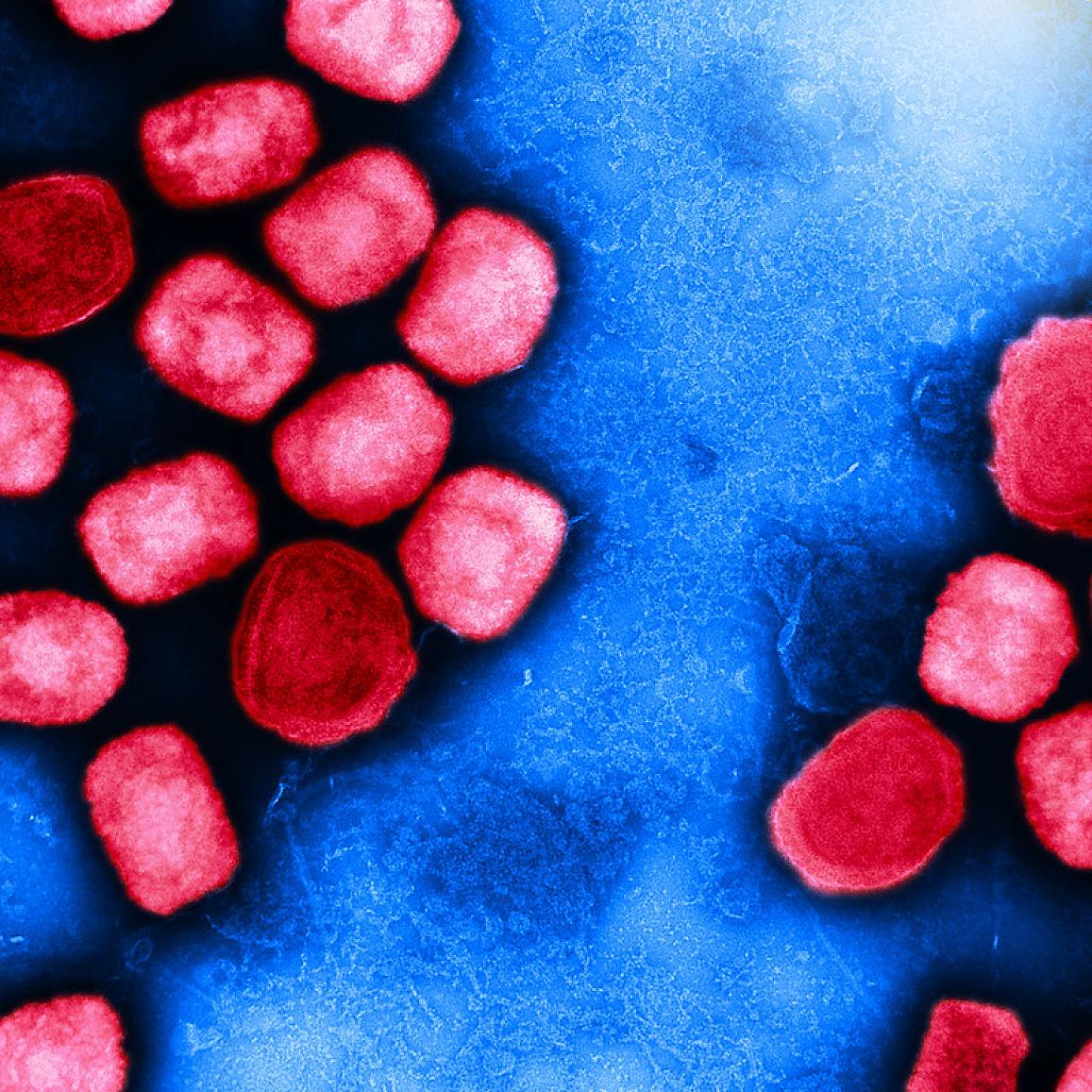
Photograph: NIAID/NIH, Public domain, via Wikimedia Commons.
Comments