


The sensitivity of a cancer blood test is not a property of the test. It is a property of the test and the population it was measured in, and those two are routinely reported as though only the first existed. Recruit people who already have a diagnosis, compare them against healthy volunteers, and the assay sees a population in which tumours are common and often advanced. Run the same assay on people who feel fine, and it sees the disease at the stage it is actually worth catching, which is the stage where there is least of it to find.
A team at Geneseeq Technology in Nanjing reported both measurements for the same test, which is what makes the paper worth reading closely. Sequencing whole genomes of plasma cell-free DNA and combining mutation-based features with fragmentomics, the physical lengths and end sequences of circulating DNA, the test reached 87.4% sensitivity at 97.8% specificity in an independent case-control cohort. In a prospective study of 3,724 asymptomatic participants, sensitivity was 53.5%.
Why it matters: Multi-cancer blood tests are being discussed as population screening. The gap between these two numbers, produced by one assay in one paper, is the clearest available statement of how much a case-control headline overstates what screening would deliver.
The study, by Bao et al., appears in Nature Medicine. The case-control work is substantial: an internal validation cohort of 3,021 patients with cancer against 3,370 controls, then an independent cohort of 677 and 687. Tissue-of-origin prediction, which determines where a positive result sends the patient, was 82.4% accurate.
The same assay, measured twice
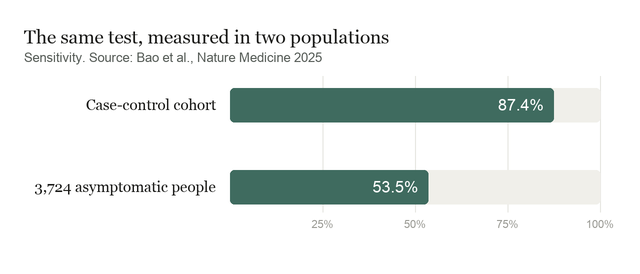
Roughly 34 percentage points separate the two sensitivities, and nothing about the assay changed between them. Three things about the designs did.
First, stage distribution. A case-control cohort recruits diagnosed patients, and diagnosed cancers skew later than screen-detected ones. Later tumours shed more DNA into blood, so they are easier to see. The authors note the prospective detections were predominantly early stage, which is the population a screening test exists to serve and the one it performs worst in.
Second, prevalence. Case-control cohorts here run near half cancer by construction. In an asymptomatic population, cancer is rare. Sensitivity and specificity are defined so as not to depend on prevalence, but the clinically meaningful quantity, the chance that a positive result means cancer, depends on it heavily. At 98.1% specificity, roughly one in fifty healthy people tests positive, and in a low-prevalence population those false positives outnumber the true detections by a wide margin.
Third, ascertainment. In a case-control study every cancer is known in advance. In a prospective screening study, a cancer missed today is only counted as missed once it surfaces later, and how many surface depends on how long participants are followed. The authors label the prospective result preliminary, and that word is doing real work.
The reported figure is stated carefully: Preliminary results from a prospective study of 3,724 asymptomatic participants showed a sensitivity of 53.5% (predominantly early stage cancers) and specificity of 98.1%.
What the design supports
The conclusion the authors draw is that These findings indicate that the MCED test has strong potential to improve early cancer detection and support clinical decision-making. Potential is the right word and the sentence does not overreach, but the evidence behind its two halves is uneven. The case-control results establish that the assay discriminates, and discriminates well, against a fair comparison group. They do not establish screening performance, and the paper's own prospective arm is the reason to say so.
What a 53.5% sensitivity would mean in practice depends entirely on what it is being compared against. Against no screening at all, for cancers with no screening programme, detecting half of them early is a substantial gain. Against colonoscopy for colorectal cancer or low-dose CT for lung cancer in eligible smokers, it is not competitive. A test evaluated across many cancers at once averages over both situations, and the average is not the decision anyone actually faces.
What the study can't say yet
The prospective arm reports sensitivity and specificity, not positive predictive value, and without the number of cancers found among the 3,724 the reader cannot compute how many positives were false. That is the number a person handed a positive result would want.
Tissue-of-origin accuracy of 82.4% was measured in the case-control cohort. Whether it holds for the smaller, earlier tumours found prospectively is untested, and it matters, because a positive result with an unreliable location points the follow-up work in the wrong direction.
Nothing here measures outcomes. Detecting a cancer earlier is not the same as changing what happens to the patient, and screening can find slow tumours that would never have caused harm while missing the aggressive ones between tests. That question needs randomised trials with mortality endpoints and long follow-up, and no blood-test paper can substitute for them.
Finally, the work comes from the company developing the assay. That is normal at this stage and does not make the results wrong, but the comparisons chosen, the thresholds set and the cohorts assembled are all decisions made by an interested party, and independent replication has not happened yet.
Quick questions
What is fragmentomics? Cell-free DNA circulates as fragments, and tumour-derived fragments differ from normal ones in length and in the sequences at their ends. Reading that pattern adds a signal beyond looking for mutations.
Why is a case-control result not enough? Because it measures whether the test separates known patients from healthy volunteers, which is an easier task than finding undiagnosed early cancer in people who feel well. The same assay scored 87.4% and 53.5% on those two tasks.
What's the one-line takeaway? A whole-genome blood test detected 87.4% of cancers when tested against diagnosed patients and 53.5% when tested on 3,724 people who felt fine, and the second number is the one screening would deliver.
Bao H, Yang S, Chen X, et al. "Early detection of multiple cancer types using multidimensional cell-free DNA fragmentomics." Nature Medicine, 2025;31(8):2737-2745. doi.org/10.1038/s41591-025-03735-2
PubMed PMID: 40425843.
Image: blood collection tube. Via Wikimedia Commons.
Comments