

Candida auris does something most fungi cannot. It settles onto human skin, spreads from patient to patient across hospital wards, and often survives the drugs meant to kill it. Since it was first identified in a patient's ear in 2009, it has turned up on every inhabited continent and landed on the World Health Organization's list of the most dangerous fungal threats. What nobody could fully explain was the biology behind two of its worst traits at once: why it favors skin, and how it becomes resistant to amphotericin B, one of the last antifungals doctors reach for.
A team led by Trinh Phan-Canh and Karl Kuchler at the Max Perutz Labs in Vienna now points to a single chemical trick. Their study in Nature Microbiology traces both the skin tropism and the drug resistance back to how the fungus senses and uses carbon dioxide.
Reading the air for CO2
At the center of the work is an enzyme called Nce103, a carbonic anhydrase. Its job is simple to state: it converts carbon dioxide into bicarbonate. The researchers combined transcriptomics and proteomics on clinical C. auris isolates and found that Nce103, together with two transcription factors named Rca1 and Efg1, forms what they call a carbonic sensing pathway. That pathway does more than housekeeping. It feeds the fungus's energy machinery.
The conversion of CO2 into bicarbonate, the team reports, sustains the mitochondrial energy metabolism that C. auris needs to colonize human skin and to hold on in nutrient-poor spots where there is little to eat. Skin is exactly that kind of environment. It is dry, low on free nutrients, and hostile to many microbes. The carbonic sensing pathway appears to be part of how this fungus makes a living there.
The same pathway also ties into resistance. The authors show that the carbonic sensing pathway contributes to amphotericin B resistance by tuning mitochondrial energy functions in clinical isolates. That connects two problems clinicians usually think about separately. The machinery that helps the fungus persist on a body is entangled with the machinery that helps it survive treatment.
Bacteria that feed the fungus
One finding stands out because it reaches beyond the fungus itself. C. auris does not live alone on skin. It shares that surface with bacteria. The Vienna group found that bacterial skin colonizers use an enzyme called urease to release CO2, and that this bacterial gas sustains C. auris fitness and helps it colonize skin.
So the fungus is not entirely dependent on its own CO2 supply. Its neighbors can top it up. That is a reminder that infection is rarely a single organism acting in isolation. The microbes already living on us can, without any coordination or intent, make conditions friendlier for a dangerous newcomer.
Where this could lead
The practical hope here is re-sensitization. If blocking the carbonic sensing pathway weakens both the fungus's grip on skin and its resistance to amphotericin B, then an inhibitor of Nce103 might do two useful things: strip away colonization on the skin of vulnerable patients, and make an existing drug work again. Carbonic anhydrases are already familiar drug targets in other areas of medicine, which is encouraging for anyone trying to design such a compound.
Some caution is warranted before reading too much into this. The work maps a mechanism in clinical isolates and in skin-relevant conditions, but it is not a treatment. No inhibitor has been shown here to cure or prevent infection in people, and moving from a molecular pathway to a safe, effective therapy is a long road with a high failure rate. The bacterial CO2 contribution also raises questions the study opens rather than closes, since human skin carries a shifting mix of microbes that will differ from patient to patient.
Still, the appeal of the finding is its economy. One enzyme, sitting where carbon dioxide meets energy metabolism, seems to underwrite two of the features that make C. auris so hard to control. Aim at that node, and you might loosen its hold on both fronts at once.
Phan-Canh, T. et al. "Candida auris skin tropism and antifungal resistance are mediated by carbonic anhydrase Nce103." Nature Microbiology, 2026. doi.org/10.1038/s41564-025-02189-z
PubMed PMID: 41436656.
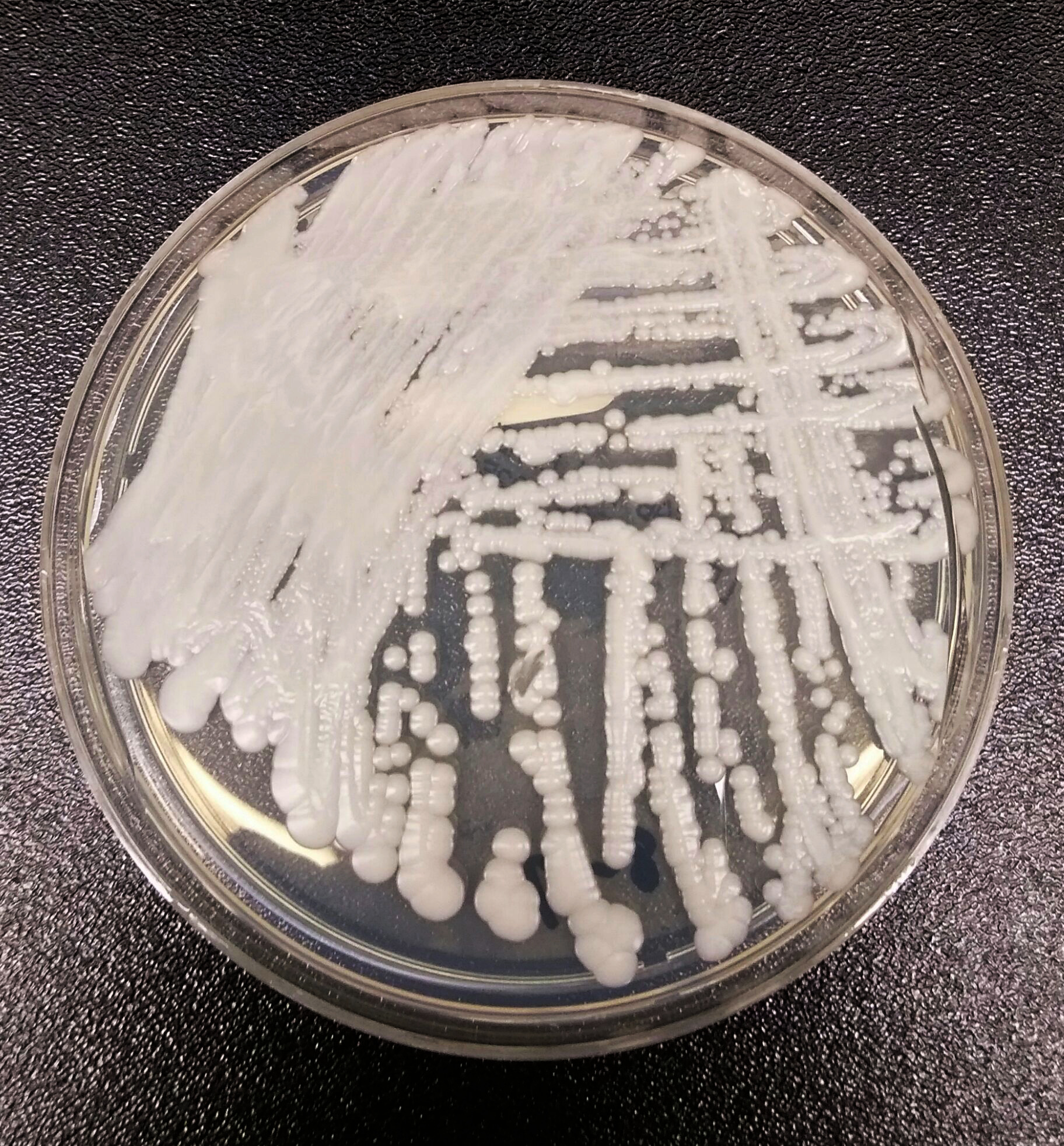
Photograph: Shawn Lockhart, CDC Public Health Image Library, Public domain, via Wikimedia Commons.
Comments