Bermuda sits alone in the open Atlantic, roughly a thousand kilometres from the nearest continent. For a reef fish, getting there means a one-way ride on ocean currents as a tiny drifting larva. A study published this week in Molecular Ecology looked at how one abundant species makes that journey, and found something lopsided. Larvae keep washing up on Bermuda's reefs. Almost nothing genetic flows back out.
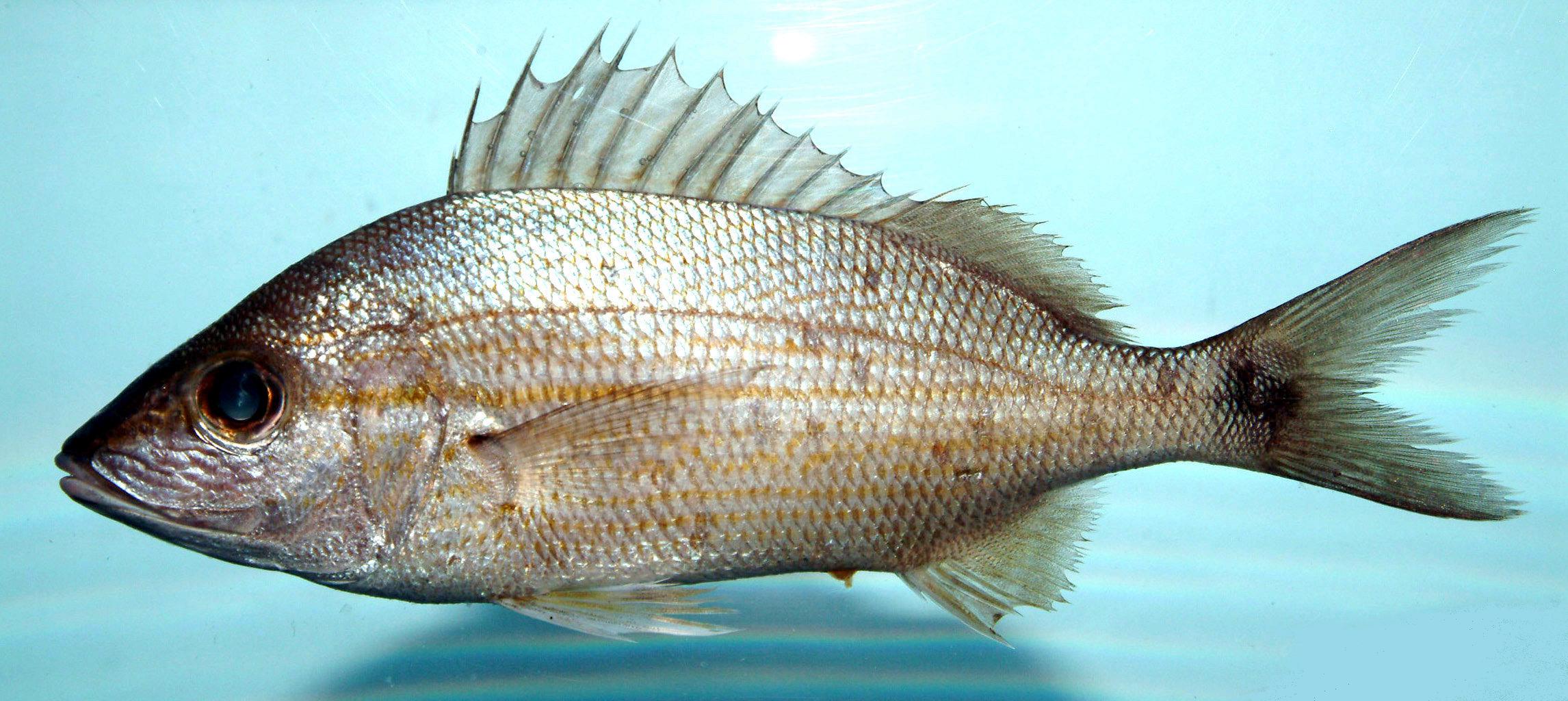
The fish is the tomtate, Haemulon aurolineatum, a small silvery grunt with a yellow stripe that schools over reefs from southern Brazil all the way north to Bermuda. It is common, unglamorous, and exactly the kind of species that gets overlooked. That ubiquity is what makes it useful. If you want to trace how ocean currents stitch reef populations together across an entire ocean basin, you want a fish that lives everywhere.
Reading gene flow across an ocean
The team, led by Melissa Scheel-Dalmau, sampled tomtate from 22 locations spanning every major biogeographic province in the fish's range. They combined genome-wide SNP data, mitochondrial DNA, and a fresh look at body shape to map how the populations connect. Three main genetic groups fell out of the analysis: one covering the Caribbean and southwestern Atlantic, one in the Gulf of Mexico, and one all by itself in Bermuda. The Caribbean group had further structure inside it, hinting at finer divisions along that vast stretch of coastline.
Known oceanographic barriers left their fingerprints. Breaks in the eastern and western Caribbean showed up as points of genetic separation. Along the coasts of Brazil and the Guianas, by contrast, currents acted as corridors, moving genes northward. So the map of who is related to whom tracks the physical map of how water moves.
A sink at the end of the line
Bermuda is the striking case. The migration modelling showed gene flow into the island population that was strong but one-directional. Larvae arrive in episodic pulses from the Caribbean and the Gulf, seeding the reefs there, but the reverse trip essentially does not happen. In population-genetics terms, Bermuda is a demographic sink: a place that depends on outside arrivals to stay stocked, while contributing little back to the rest of the range. The authors call this the "Bermuda Triangle effect," their name for how an isolated, hard-to-leave outpost accumulates its own genetic identity over time.
That isolation has consequences over long stretches of time. The analysis suggested the groups diverged early, then kept exchanging migrants unevenly. Cut off enough, a peripheral population starts to drift apart. When the researchers ran a formal species-delimitation method, it flagged three lineages as distinct enough to be separate species. The team was more cautious. They read the tomtate groups as subspecies instead: measurably different in both genome and body shape, but not yet reproductively sealed off from one another.
What the genetics can and cannot say
This is a snapshot of pattern, not a live recording of fish on the move. The gene-flow estimates come from statistical models of DNA and demographic history, and they line up well with earlier physical simulations of how larvae drift, but they are inferences rather than tracked individuals. The subspecies call is a judgment about where to draw a line on a continuum, and reasonable taxonomists could draw it elsewhere. The work also does not tell us how climate-driven shifts in currents or warming water might redraw these connections in the decades ahead. It describes the arrangement as it stands.
Still, the practical point is clear enough. Reef fish populations that look interchangeable on a map can be wired together in very uneven ways. A place like Bermuda may hold a distinctive slice of a species' diversity precisely because it is so hard to reach and so hard to leave. Manage it as just another dot on the range, and you risk losing something that took a very long time to form.
Scheel-Dalmau, M. et al. "A 'Bermuda Triangle' Effect Shaping Reef Fish Connectivity Across the Western Atlantic." Molecular Ecology, 2026. doi.org/10.1111/mec.70447
PubMed PMID: 42340142.
Photograph: SEFSC Pascagoula Laboratory, Collection of Brandi Noble, NOAA/NMFS/SEFSC, Public domain, via Wikimedia Commons.
Comments