
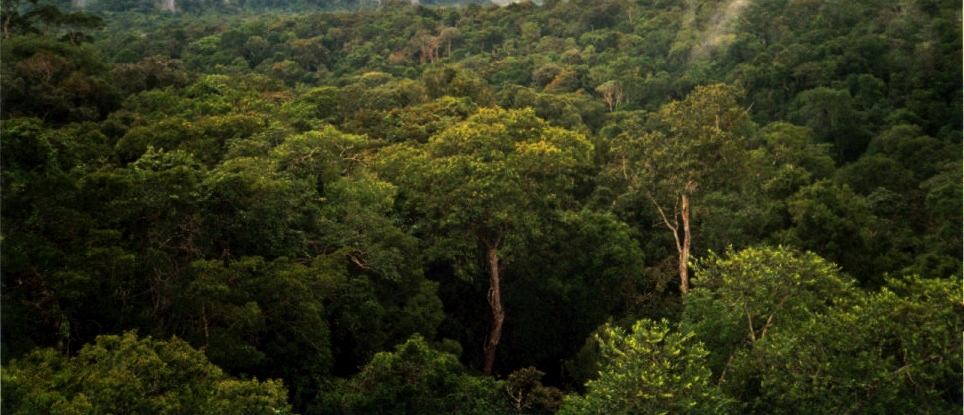
North of Manaus, in central Brazil, a patch of Amazon forest has been watched, tree by tree, for more than thirty years. Researchers tagged the trees, tracked which ones lived and died, and recorded when the rains failed. That patience turned out to matter. When they stacked the demographic record against two brutal El Nino droughts and a set of climate models, a warning emerged that goes well beyond one plot of jungle.
The study, published in Nature on 10 December 2025 by Jeffrey Chambers and colleagues, treats the Amazon's recent hot droughts as something more than bad weather. They read them as a preview. Under continued warming, the authors argue, large stretches of the tropics will slide into a climate state that has no present-day equivalent. They call it "hypertropical."
What the long record shows
Tropical forests are the warmest and wettest biome on Earth. That makes them hard to study under future conditions, because there is nowhere hotter and wetter to look. So the team synthesized several datasets instead of relying on any single one.
The demographic data came from a selective logging experiment with more than 30 years of annual measurements. During the most intense droughts, tree mortality rose. The trees that died were not random. Fast-growing pioneer species with low-density wood took the worst hits. These are the opportunists that shoot up in gaps and grow cheap, soft tissue. That strategy works when water is plentiful. It fails when the soil dries out.
Then the researchers turned to physiology. Field measurements during the 2015 and 2023 El Nino droughts revealed a soil moisture threshold. Above it, trees transpired normally. Below it, transpiration collapsed fast. Once rainless days pushed conditions past that point, the drought deepened on itself, raising the risk of two ways a tree can die: hydraulic failure, where the water column inside the plant breaks, and carbon starvation, where a tree shuts its pores to save water and slowly runs out of energy.
The hypertropical projection
The third piece came from climate models in the Coupled Model Intercomparison Project Phase 6. Under high-emission scenarios, the models push a large area of tropical forest into that hotter, no-analogue state by 2100. In a hypertropical climate, ordinary dry-season months would routinely cross the mortality thresholds the team identified in the field. That is the mechanism behind the dieback risk. It is not one catastrophic year. It is normal dry seasons behaving like today's worst droughts, over and over.
The framing is what gives the work its edge. Droughts in the tropics are already arriving at successively higher temperatures. Each one, in the authors' words, is a harbinger. They offer a live window into conditions that models say are coming, and a chance to study how the forest breaks before it breaks for good.
Reading the limits
Some caution is worth holding onto here. The demographic backbone of the study is one central Amazon site, so extending its exact numbers across the whole basin is a stretch the paper does not fully make. The 2100 projections depend on high-emission scenarios and on how well global models capture tropical rainfall, which remains one of the shakier parts of climate modeling. And forests can respond in ways short records miss, through species turnover or acclimation. The mortality thresholds are measured, but whether every corner of the tropics tracks them is an open question.
Still, the direction is hard to wave off. The trees most exposed are the fast growers that help forests recover after disturbance, which means repeated hot droughts could erode the Amazon's ability to bounce back at the same time they raise the odds of it dying back. A forest that stores a large share of the planet's living carbon is being asked to survive a climate it has never seen. This study is one attempt to watch that happen in slow motion, while there is still time to learn from it.
Chambers, J. et al. "Hot droughts in the Amazon provide a window to a future hypertropical climate." Nature, 2025. doi.org/10.1038/s41586-025-09728-y
PubMed PMID: 41372411.
Photograph: Phil P Harris, CC BY-SA 2.5, via Wikimedia Commons.
Comments