
Almost everyone born with Down syndrome carries a quiet biological countdown. The extra copy of chromosome 21 that defines the condition also carries a gene called APP, the blueprint for the amyloid protein that clumps into plaques in Alzheimer's disease. With a third dose of that gene running from birth, the plaques begin gathering decades early, and by their sixties the large majority of people with Down syndrome show the full pathology of Alzheimer's in their brains.
Knowing that a disease is coming is not the same as being able to see it arrive. The tools that confirm Alzheimer's pathology, a PET brain scan or a spinal tap, are expensive, uncomfortable, and hard to deliver to adults with an intellectual disability who may not sit still in a scanner or consent easily to a needle in the spine. So a group at the Epstein Family Alzheimer's Therapeutic Research Institute at the University of Southern California, led by Zinayida Schlachetzki, asked a plain question: could a tube of blood do the job instead?
Why it matters: People with Down syndrome develop Alzheimer’s more predictably than almost any other group, yet are rarely offered the newest tests because PET scans and spinal taps are hard to deliver to them. A simple blood draw that matches the scan could finally bring this community into monitoring and the treatment trials now reaching the clinic.
One protein fragment, two machines
The blood marker they tested is called p-tau217, a phosphorylated piece of the tau protein. As amyloid builds up in the brain, tau chemistry shifts in step, and tiny amounts of this altered fragment spill into the bloodstream. It has become one of the most reliable blood signals of Alzheimer's biology in the general population, but almost no one had checked whether it holds up in Down syndrome, where the underlying disease is genetically driven rather than the slow sporadic version most people develop.
The team drew blood from 39 adults enrolled in a national research group called the Trial-Ready Cohort for Down Syndrome, then ran each sample through two fully automated commercial platforms: a mass-spectrometry test from C2N Diagnostics and an immunoassay from Fujirebio. To judge the blood results, they compared them against amyloid PET scans, treating a scan reading above 18 centiloids as the marker of genuine Alzheimer's pathology.
The blood kept pace with the scanner
Both blood tests tracked the brain scans closely. The Fujirebio assay reached an area under the curve of 0.94, and the C2N test 0.91, where 1.0 would be a perfect match and 0.5 no better than a coin flip. Both correctly flagged 88 percent of the people who actually had amyloid pathology, and correctly cleared 90 to 94 percent of those who did not. Overall accuracy landed at 90 and 92 percent. Those figures put a single automated blood measurement roughly on par with more elaborate combinations of markers, using nothing more than a routine draw. The authors conclude that these automated tests “offer strong potential for routine AD screening.”
That matters because the practical gap here is enormous. A PET scan can cost several thousand dollars and requires specialized equipment and a cooperative patient; a blood test can be collected in a clinic, a group home, or a family doctor's office. For a population that develops Alzheimer's more predictably than almost any other, and yet is chronically underserved by dementia care, an accessible test changes who can actually be evaluated, monitored, and someday enrolled in treatment trials for the amyloid-targeting drugs now reaching the clinic.
What the study can't say yet
This was, by the authors' own description, an exploratory study, and its limits are worth stating plainly. Thirty-nine people is a small group, and the confidence ranges around the numbers are wide, with some stretching all the way to a perfect but uncertain 1.00. The cutoff values that separated positive from negative were tuned on this same small sample, which tends to flatter performance; the real test is whether the same thresholds work on fresh, independent groups. The study is also a snapshot in time, comparing blood to scan on a single day, so it cannot yet say how early the blood signal rises or how well it tracks the disease as it worsens. And a test that misses roughly one in eight cases is a screening aid, not a verdict. None of this tells us whether acting on an earlier result helps anyone live better, which is a separate question that only treatment trials can answer.
A test that meets people where they are
What the work does establish is that a marker validated mostly in the wider population behaves sensibly in the genetic form of Alzheimer's that shadows Down syndrome, and that two off-the-shelf automated platforms can read it accurately. Larger studies are already the obvious next step, with more participants, independent cutoffs, and repeated draws over time to see whether the blood signal can flag trouble before symptoms show.
For families who have long watched this particular countdown with little to measure it by, the appeal is less about the technology than about access. A test that travels to the patient, rather than demanding the patient travel to a scanner, is the kind of tool that decides whether a whole community is included in the next chapter of Alzheimer's care or left out of it.
Quick questions
Is this an approved test people can get now? Not yet. This was a small exploratory study in 39 adults; the thresholds need to be confirmed in larger, independent groups before routine clinical use.
How accurate was the blood test? The two automated assays matched amyloid PET scans with roughly 90–92% overall accuracy, correctly flagging about 88% of people who had Alzheimer’s pathology.
What is the one-line takeaway? A routine blood measurement of a tau fragment came close to matching costly brain scans at spotting Alzheimer’s pathology in adults with Down syndrome — a group usually left out of the newest tests.
Schlachetzki et al. "Exploring automated plasma phospho-tau217 assays for the diagnosis of Down syndrome-related Alzheimer's disease." Communications Medicine, 2026. doi.org/10.1038/s43856-026-01709-0
PubMed PMID: 42230953.
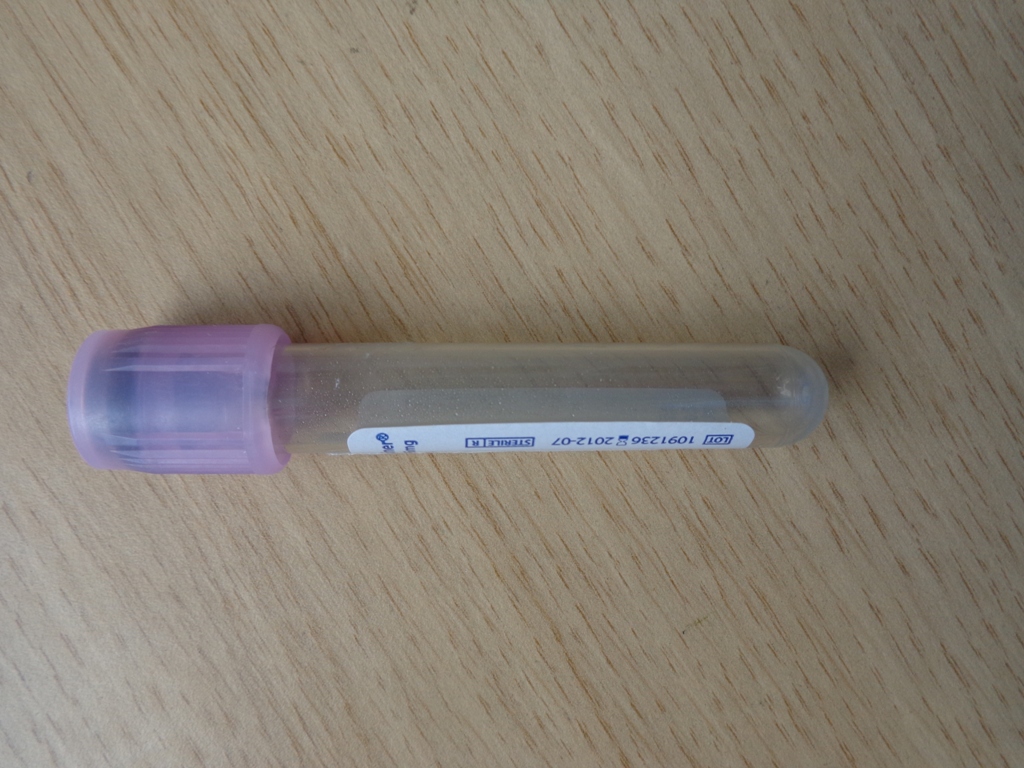
Image: Blood collection tube. AfroBrazilian, CC BY-SA 3.0, via Wikimedia Commons.
Comments